
RFID Has Evolved Beyond Tag Reads
RFID is a proven way to identify assets, inventory, tools, materials, and shipments without requiring direct line-of-sight scanning. But the value of RFID increases significantly when tag reads are connected to real business workflows.
Modern operations need more than visibility. They need RFID events to trigger action, update systems, support exception handling, and give teams confidence that the physical activity happening on the floor is reflected accurately in the software that runs the business.
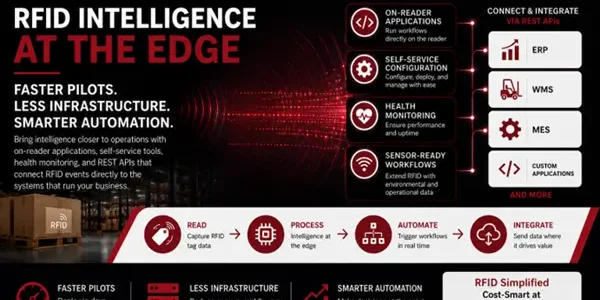
That is the purpose of RAPID RFID at the Edge: bring RFID intelligence closer to the point of activity so customers can start faster, operate with less complexity, and scale with confidence.
Why Edge Intelligence Matters
Traditional RFID deployments can involve tags, readers, middleware, local servers, custom integration work, and multiple handoffs before a customer can prove value. That model may still be appropriate for complex enterprise deployments, but it can slow down pilots and create unnecessary site complexity for focused use cases.
RAPID RFID at the Edge is designed to reduce that friction. By using compatible RFID readers as intelligent edge devices, more logic can be placed closer to where tag activity occurs. The result is a more practical deployment model for asset tracking, inventory visibility, shipment verification, and operational automation.
On-Reader Applications Reduce Site Footprint
One of the most important product value drivers is the ability to run application logic directly on compatible RFID readers. Instead of treating the reader as a simple data collection device, RAPID RFID can use the reader as part of the automation layer.
This approach can reduce the need for additional client-site servers or middleware, support localized event handling, and simplify the path to a pilot. For customers, that means less infrastructure to plan, deploy, secure, and maintain before the RFID use case can be validated.
Reader-Side Queueing Helps Preserve Tag Reads
RFID data capture should be resilient. In real-world environments, temporary network interruptions can occur. Reader-side tag-read queueing can help preserve events during short connectivity gaps so the solution is not entirely dependent on uninterrupted network availability at every moment.
For operations teams, that supports greater confidence in the continuity of RFID data capture. For IT teams, it helps reduce risk during pilot and production deployments.
Self-Service Configuration Creates a Faster Path to Value
Self-service configuration is a critical part of making RFID more scalable. Customers and internal teams should be able to configure facilities, readers, workflows, events, alerts, and integrations with less custom development for every deployment.
The roadmap toward self-service setup supports a more repeatable implementation model. Customers can start with a focused use case, prove value quickly, and expand into additional locations, readers, or workflows over time.
RFID Platform Health Monitoring Improves Operational Visibility
RFID deployments depend on the reliability of readers, connections, event processing, and supporting workflows. RAPID RFID platform health monitoring helps teams maintain better visibility into RFID system status and operational readiness.
This is especially important as RFID moves from a pilot tool to an operational system. Monitoring uptime, reader status, firmware posture, connection health, and event flow helps teams identify issues before they disrupt business processes.
Sensor-Ready Workflows Extend RFID with Operational Context
RFID identifies what was detected. Sensor-ready workflows can add context around the event. That context may include environmental data, equipment status, door or portal activity, motion signals, or other operational inputs.
This is where RFID and IoT naturally come together. Rather than treating IoT as a separate platform, operations teams can use it as a practical extension of RFID workflows, combining readers, sensors, devices, and APIs to automate more of the business process.
REST APIs Connect RFID Events to Business Systems
RFID data becomes more valuable when it can update the systems that run the business. REST APIs create a modern integration path for connecting RFID events to ERP, WMS, MES, dashboards, custom applications, reporting tools, and workflow platforms.
With API-driven integration, RAPID RFID can support use cases such as inventory updates, asset movement events, shipment validation, exception alerts, replenishment triggers, and operational dashboards.
Start with a Pilot, Scale with Confidence
The best first step is usually a focused pilot. A pilot should validate a specific operational workflow, such as tracking high-value assets, automating inventory movement, verifying dock activity, or connecting RFID reads to an existing business system.
RAPID RFID at the Edge gives customers a practical path to start smaller, validate faster, and expand when the business value is clear.

Vertical Systems is a software company with core offerings centered around RFID technologies. VSI’s RAPID RFID product suite offers a wide range of solutions to improve asset visibility and reduce labor costs.


